History & Development
The evolution of the Arcadia Community Centre framework.
Arcadia Community Centres were conceptualised by Sholi Loewenthal and later in collaboration with Dr Joseph H. Berke. As a framework, they evolved and synthesised from two distinct areas of practice: community cohesion and mental health.
They originally stemmed from a recognition that modern communities, particularly modern urban communities, have become increasingly dislocated and fragmented. Sholi began investigating this in 1999 and by 2004 had developed the initial blueprint for engage.re - a technological apparatus enabling communities to cohere at any scale. But over the subsequent years of investigation and enquiry, it became increasingly clear to Sholi that digital tools were not enough. Missing in many modern, particularly urban communities was a fundamental ingredient for society to cohere: the physical spaces at the local community level where everybody wants to be once or more a week, a place to forge shared understanding through relationships, friendships and partnerships developed in face to face interaction and activity.
Early on, Sholi was led by a deep interest in the psychology of the individual and society: the social constructs and institutions that fragment, and those that help individuals and societies cohere and thrive. Sholi's mother, Professor Kate Loewenthal is a leading figure in the field of psychology & religion. Close friends and acquaintances receiving NHS mental health support - as well as years serving as a Samaritans volunteer - gave Sholi a personal insight into shortcomings of current mental health delivery when compared with the person, issue and context approaches to mental health, pioneered Dr Joseph H. Berke (who was a close family friend) and his peers, like R.D. Laing. Increasingly, Sholi came to see Dr Berke's approach as crucial to a functioning and healthy society and, in 2016, Sholi asked Dr Berke to be his mentor - and they began working together.
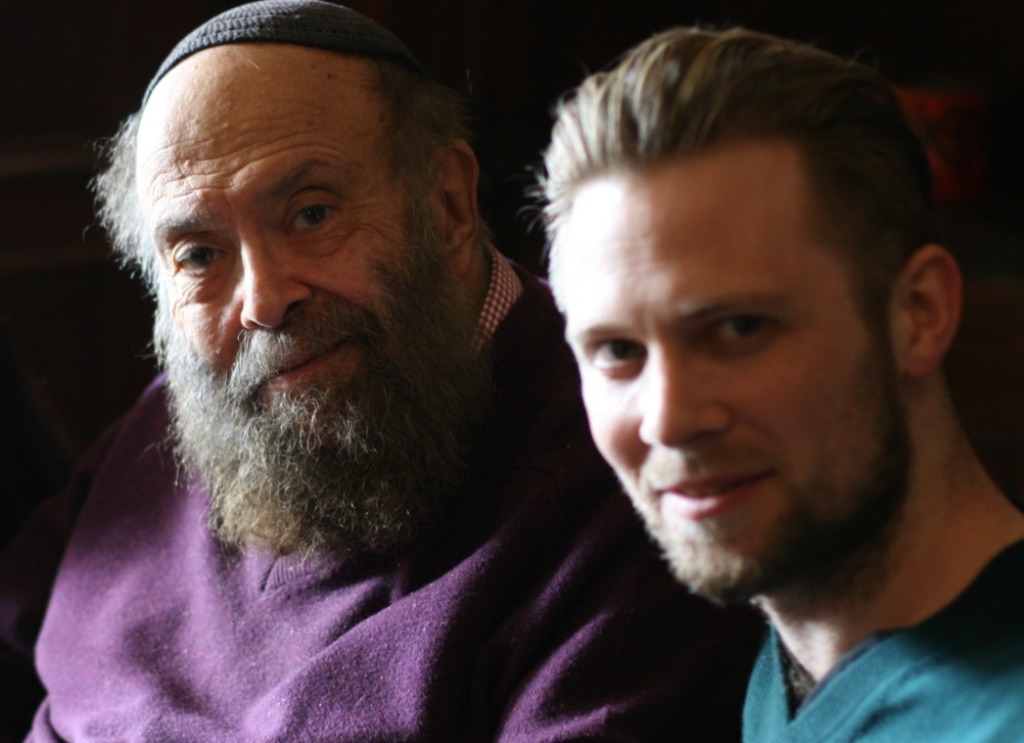
Dr Joseph H. Berke with Sholi Loewenthal, 2018. Credit: Brigid Bowen, Compassionate Mental Health
In 2018, Joe asked Sholi to accompany him to the Compassionate Mental Health conference organised by Brigid Bowen, which brought together mental health stakeholders, from policy makers to mental health professionals and those currently going through crisis, for several days of workshops and discussions. The Compassionate Mental Health conference demonstrated how the therapeutic influence could be defused within a social setting, and Sholi immediately began developing with Brigid ways to expand this methodology into replicable community frameworks. After a series of iterative conceptualisations, Sholi married the vision of community mental health with the frameworks he'd been developing for creative, economic and civic community hubs. Dr Joseph Berke adopted the framework and joined Sholi in co-authoring the 2018 discussion paper "Wellbeing Centres" and organised a workgroup at his home bringing together local experts and practitioners, as well as consulting with his broader global network via email. Later, Joe wanted to call the community centres "Arcadia", with the meaning "a place of peace and simplicity".
Locating primary mental health support within the context of the 'community's living room', a highly inspiring, energising and productive setting, redefines mental health support when compared to other approaches that separate (alienate) those in MH crisis from community.
The mental health provision delivered within Arcadia Community Centres will also be based on the person, issue and context approaches to mental health pioneered by Dr Joseph Berke and his peers. On a practical level, Dr Joseph Berke's approach encourages less reliance on medication. Instead, it promotes understanding mental health crisis as a feature of latent potential inhibited by distressing internal and external factors. To that end, the approach focuses on overcoming the distress through understanding its causes and acquiring the necessary skills to overcome their inhibiting capacity, thereby resulting in the person unlocking their inherent potential.
Today, the approaches pioneered by Dr Berke and his peers have inspired many across the field to seek more holistic and empowering approaches to psychotherapy, with numerous experiments around the world, such as Satoria, Arbours, Trieste and many others.
The Arcadia Community Centre framework aims to formulate these approaches as the standard of mental health delivery.
Our goal, at Sense Future, is a replicable framework that can be developed carefully through pilots and then adapted by each community according to its needs, rolled out across the UK and beyond.